




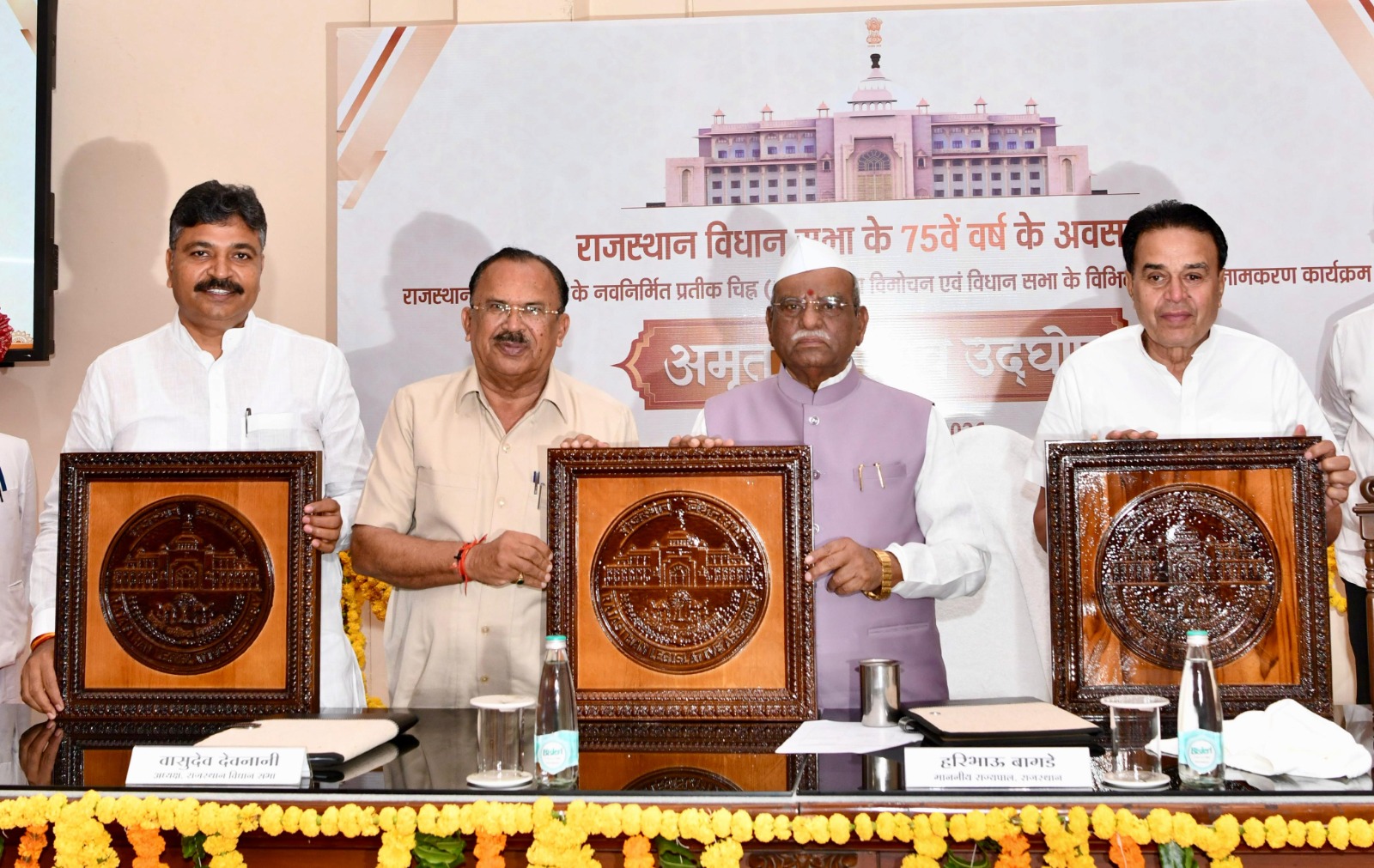
The Assembly Emblem is a Symbol of Rajasthan’s Culture – Governor
The Assembly is a Sacred Center of Hope for Millions of Citizens – Devnani
Devotion to the Nation, Legislative Duty, Public Service, and Constitutional Propriety: The Guiding Mantra – Vasudev Devnani
The State View Sunil Sharma
Jaipur. On Monday, Governor Haribhau Bagde and Rajasthan Legislative Assembly Speaker Vasudev Devnani inaugurated the ‘Amrit Mahotsav’ (Diamond Jubilee celebrations) marking the 75th year of the Rajasthan Legislative Assembly by unveiling the Assembly’s official emblem and the nameplates for its 13 gates.
Speaking on the occasion, the Governor stated that the Legislative Assembly is the sacred temple of democracy. The Rajasthan Legislative Assembly boasts a glorious history. Although the Assembly was formally constituted in independent India in 1952, its origins in Rajasthan date back to 1913—even before independence—when Maharaja Ganga Singh established a ‘Representative Assembly.’ The unveiling of the official emblem on the occasion of the Assembly’s ‘Amrit Kaal’ (Diamond Jubilee era) holds immense significance.
The Governor noted that the logo—designed at the initiative of Assembly Speaker Devnani—aptly represents the collective ethos of the people of Rajasthan. Discussing the imagery incorporated into the emblem—specifically the State Tree, the *Khejri*, and the Assembly building itself—he remarked that it symbolizes the resilience and festive spirit of the people of Rajasthan, who thrive even amidst the region’s challenging geographical conditions. He further described the *Khejri* as the ‘Kalpa Vriksha’ (the wish-fulfilling tree) of Rajasthan. Touching upon the cultural reverence for trees—exemplified by the sacrifices made to protect the *Khejri*—the Governor added that the inclusion of the Camel and the *Godawan* (Great Indian Bustard) in the emblem serves as a symbol of the culture of harmony.

Recalling the legacy of Ganesh Vasudev Mavalankar, the first Speaker of India’s Lok Sabha, the Governor recounted an anecdote: A man once approached Mavalankar and said, “I teach economics. If you require any expertise related to management, please let me know.” Mavalankar observed that the man had piled his plate with far more food than necessary, and after eating, left a significant portion of it unfinished. He remarked, “If you cannot even properly manage your own meals, how do you expect to manage anything else?” Governor Bagde stated that, alongside exemplary conduct, it is essential to put the principles of management into practice in every aspect of life. He also emphasized the need to improve educational management for the underprivileged and impoverished sections of society.
The Governor asserted that a nation progresses primarily through education. The talents of its children serve as catalysts for this progress. He stressed that education must be translated into practical application. He urged everyone to collectively deliberate on how to ensure that all schools are of high quality and how to provide practical, applied education within them. The Governor also shared anecdotes from his tenure as the Speaker of the Legislative Assembly in Maharashtra, noting that democracy is strengthened only when we remain as conscious of our duties as we are of our rights. He commended the initiative to name the various entrances of the Legislative Assembly after places associated with the valor and heroism of the land of Rajasthan.
Rajasthan Legislative Assembly Speaker Vasudev Devnani stated that, during this ‘Amrit Kaal’ (Golden Era) of the Rajasthan Legislative Assembly, their resolve and future vision are firmly rooted in the unwavering trust of the people. He noted that the Rajasthan Legislative Assembly has become the first legislative body in the country to adopt a distinct official emblem (logo). As a witness to a glorious history of the continuous pursuit of democracy, public trust, and constitutional propriety, the Rajasthan Legislative Assembly has played a historic role—evolving from the era of the Rajputana princely states—in the creation of modern Rajasthan, the establishment of democratic values, and the empowerment of the tradition of representative governance.
*The Assembly Building: A Sacred Hub of the Hopes of Millions of Citizens*
Devnani remarked that the Assembly’s logo serves as a vivid symbol of the region’s 75-year-old democratic tradition, public aspirations, and constitutional pride. The image of the Assembly building, prominently featured within the emblem, stands as the central hub of the hopes and dreams of millions of citizens. The Ashoka Pillar, majestically adorning the apex of the emblem, symbolizes the principles of Indian statecraft, truth, justice, and unwavering devotion to duty. The Great Indian Bustard (*Godawan*) depicted in the emblem represents Rajasthan’s unique cultural and natural identity, while the *Khejri* tree conveys a message of sacrifice, resilience, and the tradition of working for the public good. Furthermore, the camel and the Great Indian Bustard collectively symbolize the endurance, spirit of struggle, and inspiration for continuous progress inherent to the desert land (*Marudhara*) of Rajasthan. He stated that “Rashtraya Dharmanishtha Vidhayika” (A Legislature Devoted to the Nation) serves as the guiding mantra—the very soul—of the public service and constitutional propriety upheld by the Rajasthan Legislative Assembly. A legislature characterized by devotion to the nation, justice, and a strong sense of duty works tirelessly for the sake of truth, equity, balance, and public welfare. The greatest strength of a democracy lies, in fact, within the fulfillment of one’s duties. Devnani remarked that, in Indian philosophy, the concept of *Dharma* encompasses truth, justice, duty, balance, and the welfare of the people. The Legislative Assembly, as a legislative body, strives to fulfill the aspirations of the public while strictly adhering to the bounds and principles of the Constitution.
*Names of the Gates: Symbols of Democracy’s Core Ideals*
Describing the naming of the various gates of the Legislative Assembly building as a historic and value-driven decision, Speaker Devnani stated that the names of these gates serve as symbols of the fundamental ideals of democracy. Every individual entering through these gates will feel that they are not merely stepping into a building, but rather into a sacred sanctuary of democratic ethos. Devnani explained that, within the Rajasthan Legislative Assembly complex: the Northern Gate (Brass)—through which the Governor, Speaker, Chief Minister, and Leader of the Opposition enter—has been named *Kartavya Dwar* (Gate of Duty); the Southern Gate—through which the public, the true source of the legislature’s power, enters—has been named *Shakti Dwar* (Gate of Power); the Western Gate—through which the Members of the Legislative Assembly (MLAs) enter—has been named *Sushasan Dwar* (Gate of Good Governance); the Eastern Gate—through which officials enter—has been named *Sankalp Dwar* (Gate of Resolve); and the Northern Gate (Temple side)—through which distinguished dignitaries arrive—has been named *Shaurya Dwar* (Gate of Valor).
*The Legislative Assembly Building: A Living Portrait of Democracy*
Assembly Speaker Devnani remarked that dedicating the outer gates of the Legislative Assembly building to the names of Rajasthan’s distinct regions—Braj, Shekhawati, Vagad, Hadoti, Marwar, Mewar, Merwara, and Dhundhar—represents an innovative endeavor to weave Rajasthan’s cultural diversity, heritage, and folk traditions into the fabric of its democratic institutions. He noted that Gate Number One has been named *Braj Dwar*; Gate Two, *Shekhawati Dwar*; Gate Three, *Vagad Dwar*; Gate Four, *Mewar Dwar*; Gate Five, *Marwar Dwar*; Gate Six, *Hadoti Dwar*; Gate Seven, *Merwara Dwar*; and Gate Number Eight, *Dhundhar Dwar*. Braj is renowned for devotion and cultural harmony; Shekhawati for art and entrepreneurship; Vagad for its nature-centric tribal consciousness; Hadoti for its literary and architectural traditions; Marwar for its spirit of resilience; Mewar for national pride and sacrifice; Merwara for its saintly traditions; and Dhundhar for its political and cultural vitality. He concluded by stating that, collectively, these elements constitute the very soul of Rajasthan. Today, this Legislative Assembly building embodies all these cultural currents, presenting a vibrant tableau of democracy.
*The Legislative Assembly: Witness to Historic Decisions*
Leader of the Opposition Tikaram Jully stated that the 75-year journey of the Rajasthan Legislative Assembly has borne witness to numerous historic decisions and public-welfare laws. Commending the innovations being introduced by Assembly Speaker Vasudev Devnani, he described the initiatives to make the Assembly paperless and to integrate cultural symbols with democratic institutions as praiseworthy. He further remarked that the Great Indian Bustard (*Godawan*), the Khejri tree, and the camel serve as symbols of Rajasthan’s culture and identity.
*State’s Prestige Enhanced Through Continuous Innovation in the Legislative Assembly*
Parliamentary Affairs Minister Jogaram Patel stated that Speaker Devnani has elevated the prestige of the state by introducing continuous innovations within the Rajasthan Legislative Assembly. He remarked that the official emblem would serve to represent Rajasthan’s cultural identity as well as its democratic values. Our House functions for a greater duration than other legislative assemblies, and its operational efficiency and promptness in task execution also surpass those of other states. The naming of the various gateways will serve to connect the new generation with their heritage, instilling a sense of pride in them as they enter through these portals. The rules and laws formulated by the Legislative Assembly continue to benefit the common people for years to come.
*Honoring Sher Singh, the Designer of the Emblem*
During the ceremony, Governor Haribhau Bagde and Speaker Vasudev Devnani honored Sher Singh—the designer of the newly created emblem of the Rajasthan Legislative Assembly—by presenting him with a replica of the emblem.
*Ministers and Legislators in Attendance*
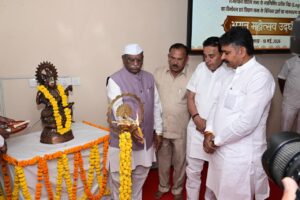
The ceremony was attended by Deputy Chief Minister Premchand Bairwa; Ministers Manju Baghmar, Otaram Dewasi, Colonel Rajyavardhan Rathore, Jhabar Singh Kharra, Joraram Kumawat, K.K. Bishnoi, and Gajendra Singh Khimsar; a large number of legislators; Principal Secretary Bharat Bhushan Sharma; and Special Assistant K.K. Sharma, along with various officers and employees of the Legislative Assembly. The ceremony commenced with the ceremonial lighting of the lamp by the Governor and the Speaker.

Author: thestateview
“The State View” में आपका स्वागत है! www.thestateview.com भारत का एक अग्रणी और सत्यप्रिय समाचार पोर्टल है, जो अपने पाठकों को सटीक, विश्वसनीय और निष्पक्ष समाचार प्रदान करने के लिए प्रतिबद्ध है। हम आपको हर क्षेत्र में, चाहे वह धर्म, राजनीति, अपराध, खेल, विज्ञान, तकनीक, मनोरंजन, स्वास्थ्य या अन्य महत्वपूर्ण घटनाएँ हों, नवीनतम अपडेट्स और तथ्यपूर्ण रिपोर्ट्स प्रदान करते हैं। हमारा उद्देश्य